
What Is OFCI? Owner Furnished, Contractor Installed Equipment Explained
A plain-English guide to OFCI in data center construction, from purchase order to energization.
Updated November 2026 · Reviewed by Sam Hagen, Founder
OFCI Meaning: OFCI stands for Owner Furnished, Contractor Installed. The owner buys the equipment, and the contractor receives it on site, sets it, connects it and supports commissioning. On data center projects, it usually covers long-lead power and cooling equipment such as switchgear, transformers and generators.
Key Takeaways
- The owner purchases and the contractor installs. Who carries risk in between is set by contract.
- OFCI is standard for long-lead data center equipment such as switchgear, transformers, generators and UPS systems.
- OFCI is not the same as OFOI (the owner installs) or CFCI (the contractor buys and installs).
- Plan receiving, storage, preservation and staging early, with a backup plan if the project is delayed.
Who Uses This Term
OFCI shows up in the contracts, schedules and drawings used by:
- Owners and hyperscalers
- Owner’s reps
- General contractors
- Electrical and mechanical subcontractors
- OEMs
- Commissioning agents
- Engineers of record (EOR)
- Architects
- Cost managers
- Procurement teams
OFCI Meaning in Plain Terms
In plain terms, the OFCI meaning is a procurement and responsibility code: it shows who buys an item and who puts it in place. Under OFCI, the owner selects the product, negotiates with the original equipment manufacturer (OEM) and issues the purchase order. The general contractor (GC) or its trade partners install it.
On data center programs, the OFCI meaning usually applies to the long-lead electrical and mechanical equipment that drives the schedule. Owners buy early to lock in production slots, so equipment often finishes before the site can accept it. What happens in the time between the factory and the job site decides whether it arrives install-ready.
OFCI means Owner Furnished, Contractor Installed. You may also see O/F-C/I or “owner-furnished, contractor-installed.” Some owners use OFE (owner-furnished equipment) for the purchase and add a second code for who installs it.
On blueprints, OFCI appears as a note, keynote or column in an equipment schedule. It tells bidders the item is furnished by others but installed in their scope. Division 01 of the specifications usually includes an owner-furnished products section (Section 01 64 00 in MasterFormat) that defines delivery, receiving, inspection and handoff duties.
Submittals still matter: installers need OEM dimensions, weights and connection data to plan pads, conduit and rigging.
OFCI vs CFCI vs OFOI vs CFOI
Four codes cover nearly every line on a responsibility matrix: who buys, and who installs.
| Code | Full Name | Who Buys | Who Installs | Typical Data Center Example |
|---|---|---|---|---|
| OFCI | Owner Furnished, Contractor Installed | Owner | Contractor | Switchgear, generators, UPS |
| CFCI | Contractor Furnished, Contractor Installed | Contractor | Contractor | Conduit, cable tray, panelboards |
| OFOI | Owner Furnished, Owner Installed | Owner | Owner or its vendor | Servers, network gear, loose furniture |
| CFOI | Contractor Furnished, Owner Installed | Contractor | Owner or its vendor | Rare in data center work |
Warranty, risk of loss and schedule responsibility follow the contract, not the code alone.
OFE (owner-furnished equipment) is the umbrella term for anything the owner buys; OFCI and OFOI are the two installation paths. GFE (government-furnished equipment) is the public-sector version. FF&E (furniture, fixtures and equipment) is often split across all four codes.
Why Data Center Owners Use OFCI
The equipment, not the building, often sets the schedule.
Medium-voltage switchgear, large transformers and generators can carry lead times of a year or more, and some equipment is ordered up to two years ahead. Buying direct lets the owner reserve factory production slots before a GC is selected and allocate equipment across sites through demand planning.
Owners with repeatable designs buy the same equipment for every building, which simplifies submittals, spare parts, commissioning and operations.
Direct purchase removes contractor markup and adds leverage on large orders. In exchange, the owner takes on expediting, logistics and interface management, and often storage risk until the equipment reaches the installer.
How OEMs Work With OFCI Equipment
On an OFCI package, the original equipment manufacturer (OEM) sells to the owner, not the contractor. That shapes who is involved at each stage.
- The owner buys from the OEM, often far ahead of construction to lock in factory production slots.
- The OEM builds the equipment and runs factory acceptance testing (FAT), which the owner often witnesses.
- After installation, the OEM performs startup and supports commissioning. That work is almost always funded by the owner.
- The general contractor, in cooperation with the owner, usually manages and schedules the OEM field service representatives for each commissioning level (Levels 1–5).
- The equipment warranty goes to the owner.
Because the warranty belongs to the owner, storage matters. OEM warranties often depend on following the manufacturer’s storage and preservation requirements, so poor storage between the factory and the job site can put the owner’s warranty at risk.
Who Does What: The OFCI Responsibility Matrix
A responsibility matrix assigns each task, for each equipment package, to one party. The split below is typical. Your contract governs.
| Task | Typical Party | Notes |
|---|---|---|
| Specification and purchase order | Owner | Owner standard |
| Expediting and factory acceptance testing (FAT) | Owner, OEM | Owner often witnesses FAT |
| Freight to first destination | Owner or OEM | Per contract |
| Receiving and inspection | Owner, logistics partner or GC | Per contract |
| Storage and preservation | GC or logistics partner | Owner-funded; payment and responsibility usually run through the GC. OEM requirements apply |
| Delivery to site and offloading | Owner, GC | Rigging coordinated |
| Setting, termination and startup | GC, trade partners, OEM | OEM startup, owner-funded; GC schedules OEM field service with the owner |
| Commissioning (Cx) and IST | Cx agent, GC, owner, OEM | Owner acceptance |
| Risk of loss and insurance | Per contract | Set by contract |
Storage is technically funded by the owner, but payment and responsibility almost always run through the general contractor.
The owner, often through an OFCI manager, issues purchase orders, tracks production, attends FAT and expedites long-lead items to meet need dates.
Check the bill of lading, verify seals, photograph the load and inspect for damage before signing. Over, short and damaged (OS&D) conditions noted at receipt are far easier to resolve than damage found later.
Waiting equipment needs the conditions its manufacturer requires: space heaters, battery maintenance and periodic inspections. Storage is technically funded by the owner, but payment and responsibility almost always run through the general contractor. This line is often left blank or assigned to “others.”
Delivery sequencing should follow the installer’s plan, not the factory’s shipping order. Rigging, cranes and site access are coordinated before the truck leaves.
The contractor sets, terminates and energizes. The OEM performs startup of its own equipment. The commissioning team runs functional tests and integrated systems testing (IST).
Who owns the risk at each handoff, and who insures it, is set by contract. Document every change of custody with dated photos and signatures.
The Equipment Journey
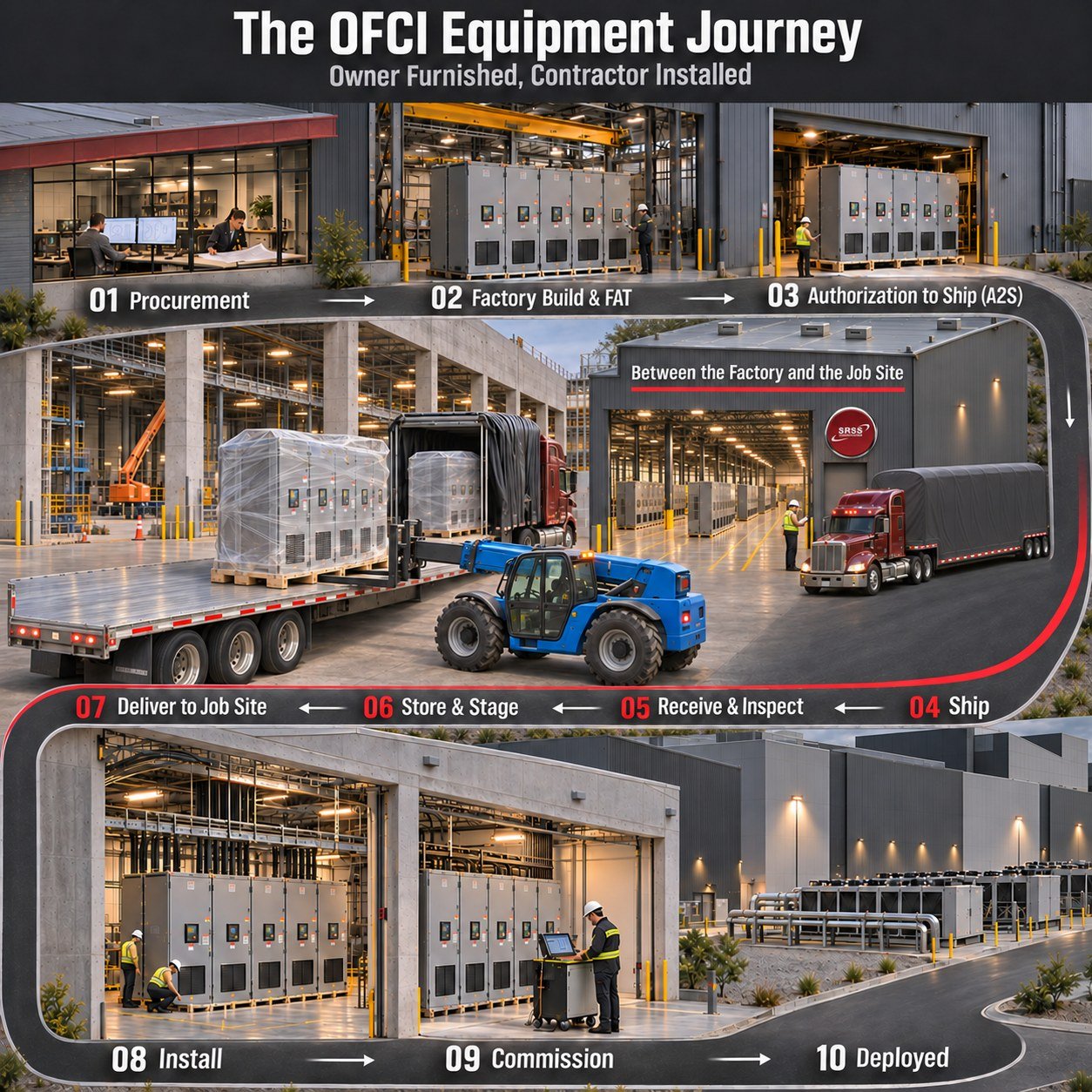
Every OFCI item follows the same ten steps, from procurement to deployed. Steps four through seven happen in the time between the factory and the job site, and that is where custody most often breaks down.
- Procurement: The owner issues the purchase order and confirms the OEM’s production slot and promise date.
- Factory Build & FAT: The OEM builds the equipment and runs factory acceptance testing, which the owner often witnesses.
- Authorization to Ship (A2S): The owner reviews FAT results and open items, then authorizes the OEM to ship. The destination and delivery window are confirmed before the equipment leaves the factory.
- Ship: Freight moves on the OEM’s or owner’s carrier, with oversize loads permitted.
- Receive & Inspect: The load is checked against the bill of lading, seals and photos are recorded, and visible damage is documented.
- Store & Stage: Equipment waits in the conditions the OEM requires, with inspections and battery maintenance on schedule, then is regrouped by building section, phase and installation sequence.
- Deliver to Job Site: Loads are released against required-on-job dates, with rigging coordinated for arrival.
- Install: The contractor sets and terminates the equipment.
- Commission: The OEM starts up its equipment, and commissioning and IST verify the system.
- Deployed: The owner accepts the system and it goes into service.
Common OFCI Equipment in Data Centers
Usual delivery models are shown; confirm each line on your own matrix.
- Medium-Voltage Switchgear (MV SWGR): Breaker lineups that distribute utility or generator power across the site. Typically OFCI.
- Low-Voltage Switchgear and Switchboards (LV SWGR/SWBD): 480/415 V lineups feeding UPS, mechanical and house loads. Typically OFCI.
- Ring Main Units (RMU): Compact medium-voltage switching units for campus loops. Typically OFCI.
- Medium-Voltage Cable (MV Cable): Feeder cable reels bought early with the gear. Often OFCI.
- Transformers (XFMR): Step utility voltage down to usable levels; often the longest-lead item. Typically OFCI.
- Generators (GEN): Diesel or gas standby units that back up utility power. Typically OFCI.
- Generator Fuel Tanks: Sub-base and day tanks shipped with or apart from generators. Typically OFCI.
- Generator Exhaust Stacks: Stack sections, silencers and hardware that often ship separately from the generator. Typically OFCI.
- Paralleling Switchgear (PSG): Synchronizes multiple generators onto a common bus. Typically OFCI.
- Uninterruptible Power Supplies (UPS): Carry critical load through power events until generators start. Typically OFCI.
- UPS Batteries and Battery Energy Storage (VRLA, Li-ion, BESS): Battery cabinets, strings and containerized storage. Typically OFCI.
- Automatic Transfer Switches (ATS): Shift load between utility and generator power. Typically OFCI.
- Static Transfer Switches (STS): Solid-state switching between two UPS sources. Typically OFCI.
- Power Distribution Units (PDU): Step down and distribute UPS power to the data hall. Typically OFCI.
- Remote Power Panels (RPP): Branch-circuit panels fed from PDUs. Typically OFCI.
- Rack PDUs (rPDU): Power strips mounted in IT racks. OFCI or OFOI.
- Busway (Busduct): Prefabricated bus sections carrying power to equipment or racks. Typically OFCI.
- Panelboards (PNL): Lighting and power distribution panels. Typically CFCI.
- Electrical Houses and Skids (E-House): Factory-built power rooms with gear pre-installed. Typically OFCI.
- Meters and Protective Relays: Devices that measure power quality and protect circuits. OFCI or CFCI.
- Load Banks (LB): Test loads used to commission generators and UPS systems. Often rented or owner-provided.
- Surge Protection and Grounding (SPD): Surge devices and grounding hardware. Typically CFCI.
- Chillers (CH): Produce chilled water for the cooling plant. Typically OFCI.
- Computer Room Air Handlers and Air Conditioners (CRAH/CRAC): Perimeter or in-row units that cool the white space. Typically OFCI.
- Air Handling Units (AHU): Air handlers serving data halls or support spaces. OFCI or CFCI.
- Fan Walls (FW): Fan arrays for air-side cooling. Typically OFCI.
- Coolant Distribution Units (CDU): Move heat between facility water and rack-level liquid loops. Typically OFCI.
- Liquid Cooling Components (TCS, RDHx): Manifolds, hoses and rear-door heat exchangers. Split; define the boundary.
- Cooling Towers (CT): Evaporative heat rejection for water-cooled plants. OFCI or CFCI.
- Air-Cooled Condensers and Dry Coolers (ACC): Heat rejection for closed-loop systems. OFCI or CFCI.
- Server Racks and Cabinets: Enclosures that hold IT equipment. OFCI or OFOI.
- Aisle Containment: Hot- or cold-aisle panels, doors and roofs. OFCI or CFCI.
- Fiber Optic Cable and Connectivity (Fiber/MPO): High-count fiber, MPO trunks and enclosures. OFCI or CFCI.
- Structured Cabling (SCS): Copper cabling, patch panels and outlets. Typically CFCI.
- Network Equipment: Switches and routers in meet-me and distribution rooms. Typically OFOI.
- Servers, GPUs and IT Hardware: Compute and storage that fill the racks. Typically OFOI.
- Cable Tray and Ladder Rack: Pathways for power and data cabling. Typically CFCI.
- Raised Access Floor (RAF): Pedestal-and-panel floor systems. CFCI or OFCI.
- Access Control (ACS): Card readers, controllers and mantraps. Split: devices OFCI or CFCI, programming OFOI.
- Video Surveillance (CCTV/VSS): Cameras and recording systems. OFCI or CFCI; servers often OFOI.
- Intrusion Detection (IDS): Sensors, door contacts and alarm panels. CFCI or OFCI.
- Distributed Antenna System (DAS/ERRCS): In-building cellular and public-safety radio coverage. CFCI or OFCI.
- Fire Alarm and Aspirating Smoke Detection (FA/VESDA): Alarm and early-warning smoke detection. Typically CFCI.
- Fire Suppression: Clean-agent or pre-action suppression systems. Typically CFCI.
- Building Automation System (BAS/BMS): Controls and alarms for mechanical systems. OFCI or CFCI.
- Electrical Power Monitoring and SCADA (EPMS/SCADA): Supervisory monitoring and control of the electrical system. OFCI or CFCI.
- Leak Detection (LDS): Sensors that alarm on coolant or water leaks. Typically CFCI.
- Furniture (FF&E): Office, NOC and support-space furniture. Typically OFOI.
- Appliances and Breakroom Equipment: Owner-standard appliances that need connections. Typically OFCI.
- Audio-Visual Equipment (AV): Displays, conferencing and NOC video walls. OFOI or OFCI.
- Prefabricated Modules and Power Trains: Factory-built halls, power blocks or cooling skids. Typically OFCI.
- Ship-Loose Parts: Components shipped separately from the main unit, such as breakers, trim, hardware, sensors and kits. Easy to lose if not tracked by tag. Follows the main equipment (usually OFCI).
- Spare Parts and Attic Stock: Owner-held spare breakers, modules and filters. Typically OFOI.
- Structural Steel and Bulk Materials: Owner-bought bulk material on some industrial programs. OFCI on some programs.
Storage and Preservation by Equipment Type
Shipping packaging is not storage packaging. When equipment waits for months, manufacturer storage instructions become part of the chain of custody and can affect the warranty. Follow each OEM manual; these are common requirements.
| Equipment | Common Storage and Preservation Requirements |
|---|---|
| Switchgear (MV and LV) | Indoor, clean, dry space; OEM bulletins commonly cite 75% relative humidity or less; space heaters energized; open bus ends protected. |
| Transformers | Stored level. Liquid-filled units keep a positive nitrogen blanket, with pressure and oil level checked on a set interval. Dry-type units stay indoors with heaters or desiccant. |
| Generators | Covered, dry storage; openings sealed; space heaters energized where equipped; starting batteries maintained with OCV checks (battery voltage checks) and charging. During long holds, starting batteries can be removed and stored separately in conditioned space. |
| Rotating Mechanical Equipment (Fans, Fan Walls and Motors) | Covered, dry storage; openings and terminal boxes sealed; motor space heaters energized where equipped; shafts turned on the interval the OEM manual specifies to protect bearings. |
| UPS Systems and VRLA Batteries | Conditioned indoor space. VRLA batteries typically need a refresh charge about every six months at 77°F (25°C) or below, and more often when warmer. |
| Lithium-Ion Batteries and BESS | Held at the OEM’s specified storage temperature and state of charge, with OCV checks (battery voltage checks) on the OEM’s interval. Local fire code may limit how much can be stored in one place. |
| PDUs, RPPs, ATS and STS | Indoor, conditioned storage; covers kept on; electronics kept dry. |
| Busway | Dry, supported flat; ends and joints protected; sections kept in installation sequence. |
| MV Cable and Fiber Reels | Reels kept upright on firm, dry ground, never laid flat; cable ends sealed or capped; reel tags kept readable. |
| E-Houses and Prefab Modules | Set level on proper blocking; doors, openings and penetrations sealed; heaters or dehumidifiers running as the OEM requires; gear inside treated like the switchgear it contains. |
| CDUs and Liquid Cooling | Clean indoor storage; ports and fittings capped to keep contamination out. |
| Racks and Low-Voltage Equipment | Indoor, conditioned; labeled by hall and row; connector ends capped. |
Staging by Phase and Sequence
Equipment rarely arrives in the order it will be installed. Factory release dates and freight decide when it ships; the installer’s plan decides when it is needed. A knowledgeable storage partner closes that gap by staging equipment in reverse, so the first items the installer needs are closest to the dock.
Equipment usually comes by building section, and gear for different phases must be kept separate so each load carries the right items for the work in front of the installer.
For example, outdoor enclosures, load bank tap boxes and outdoor switchgear are usually set before the indoor electrical rooms are ready. They are staged separately and shipped first, which enables just-in-time delivery to the installer while indoor gear stays protected until its rooms are ready.
Planning Around Required-on-Job (ROJ) Dates
The required-on-job (ROJ) date is the day the contractor needs an item on site and ready to install. Some owners call it the required-on-site (ROS) date; both refer to the same date. Plan backward from it: installation window, delivery window, staging, then factory release.
Equipment shipped to an unready site eats laydown space, gets handled twice and sits exposed to weather. Holding it off site in proper conditions and releasing it by ROJ date protects the equipment and the site plan.
Late equipment pushes setting, startup and commissioning. Weekly expediting, early warning on OEM slips and re-sequenced deliveries protect the critical path.
If the building slips after equipment has shipped, storage and preservation have to continue longer than planned. Agree in advance where equipment will go, who maintains it and how the OEM’s requirements will be met for the added time.
OFCI Receiving Checklist
Use these steps every time a load arrives.
- Confirm the expected delivery, project and purchase order number.
- Match the bill of lading to the packing list and equipment tags.
- Verify and record seal numbers before opening the trailer.
- Photograph the trailer, load, packaging and tilt or shock indicators before unloading.
- Unload using OEM lifting points and handling instructions.
- Inspect for visible damage, shortages and load shift, and note OS&D on the delivery receipt.
- Count ship-loose parts and tie them to the main equipment tag.
- Record serial numbers and assign a storage location.
- Notify the owner and OEM of exceptions within the agreed window.
Common OFCI Mistakes
Most OFCI problems start in the gap between purchase and installation. These are the ones we see most.
- No backup plan if the project is delayed. Sites slip. Without a plan for where equipment will be stored and how it will be preserved if the building is late, gear ends up on the wrong site, in the wrong conditions or with nobody maintaining it.
- Storage not assigned in the responsibility matrix. The storage and preservation line is often left blank or assigned to “others,” so no one owns heaters, battery charging or inspections.
- Lost ship-loose parts. Breakers, trim, hardware and kits that ship separately from the main unit go missing when they are not tagged and tracked with the equipment they belong to.
- Skipped receiving inspection. Signing the delivery receipt before inspecting turns freight damage into a dispute about who caused it.
- Missing manufacturer storage requirements. OEM storage and preservation instructions are easy to overlook, and missing them can affect the warranty.
- Using a general warehouse. A warehouse that does not understand how the equipment is installed or what phase it is sequenced for stores it in arrival order, which slows every release.
OFCI Risks and How Teams Reduce Them
| Risk | How Teams Reduce It |
|---|---|
| Gaps in the responsibility matrix | Assign every task, especially storage and preservation, before the first purchase order ships. |
| Damage found after signature | Inspect and photograph at receipt; note OS&D on the delivery receipt. |
| Lost identity or paperwork | Keep equipment and ship-loose parts tracked by project, tag and location from receipt to release. |
| Preservation lapses | Follow OEM storage manuals and log heater checks, inspections and battery charging. |
| Site congestion | Hold equipment off site and release it by ROJ date. |
| Project delays | Have a backup plan for storage and preservation before equipment ships. |
| Warranty disputes | Keep records showing OEM storage conditions were met. |
Check Your Understanding: 5 Quick Questions
A short self-check for anyone new to OFCI. Tap a question to see the answer.
Answer: Owner Furnished, Contractor Installed.
Answer: The contractor, meaning the general contractor or its electrical and mechanical trade partners. The OEM performs startup of its own equipment.
Answer: Required on site and required on job. They refer to the same date: when the contractor needs the item on site and ready to install.
Answer: Under OFCI, the contractor installs the owner’s equipment. Under OFOI, the owner installs it with its own staff or vendors.
Answer: At the OEM’s factory before shipment. Some owners run or repeat acceptance tests at an off-site facility before release.
OFCI Glossary
- A2S: Authorization to ship; the owner’s release that allows the OEM to ship finished equipment, usually after FAT.
- BESS: Battery energy storage system.
- CFCI: Contractor Furnished, Contractor Installed.
- CFOI: Contractor Furnished, Owner Installed.
- Cx: Commissioning; verifying systems perform as designed.
- EOR: Engineer of record.
- FAT: Factory acceptance testing, normally done at the OEM before shipment. Some owners run or repeat acceptance tests at an off-site facility before release.
- FF&E: Furniture, fixtures and equipment.
- GFE: Government-furnished equipment.
- IST: Integrated systems testing of all systems together.
- LLE: Long-lead equipment whose lead time drives the schedule.
- OCV: Open-circuit voltage; a battery voltage check.
- OEM: Original equipment manufacturer.
- OFCI: Owner Furnished, Contractor Installed.
- OFE: Owner-furnished equipment.
- OFOI: Owner Furnished, Owner Installed.
- OS&D: Over, short and damaged; exceptions noted at receipt.
- ROJ: Required on job; the date the contractor needs an item on site and ready to install. Same date as ROS.
- ROS: Required on site; another name for the ROJ date. Both refer to the same date.
- SAT: Site acceptance testing after installation.
- Ship-loose: Parts shipped separately from the main unit and installed in the field.
OFCI FAQ
OFCI means Owner Furnished, Contractor Installed. The owner buys the equipment and the contractor installs it. On data center projects, it usually applies to long-lead power and cooling equipment.
Under OFCI, the owner buys the equipment and the contractor installs it. Under CFCI, or Contractor Furnished, Contractor Installed, the contractor both buys and installs it and carries the procurement risk inside its price.
OFOI means Owner Furnished, Owner Installed. The owner buys the item and installs it with its own staff or vendors, which is common for servers, network gear and loose furniture.
CFOI means Contractor Furnished, Owner Installed. The contractor buys the item and the owner or its vendor installs it. CFOI is rare in data center work.
On drawings, OFCI marks an item the owner furnishes and the contractor installs. It usually appears in equipment schedules or keynotes, with details in the owner-furnished products section of Division 01.
In data centers, OFCI usually covers switchgear, transformers, generators, UPS systems, PDUs, chillers, CDUs and similar long-lead equipment that owners buy early to protect the schedule.
Switchgear, transformers, generators, UPS systems, batteries, PDUs, busway, chillers, CRAHs, CDUs and prefabricated power modules are the most common, along with their ship-loose parts.
For an electrical contractor, OFCI means the owner supplies the gear, and the contractor receives it on site, sets it, terminates it and supports startup. Estimators price the labor and handling, not the equipment.
OFE is any equipment the owner buys directly. It is then installed by the contractor (OFCI) or by the owner (OFOI).
An OFCI manager tracks owner-furnished equipment from purchase order through factory acceptance testing, delivery, receiving and handoff to the installing contractor. The role covers expediting, delivery sequencing, asset tracking, chain of custody and reporting against required-on-job dates.
It depends on the equipment. Some long-lead items, such as large transformers, medium-voltage switchgear and generators, are often ordered up to two years ahead because of lead times and current factory production constraints.
No. There is no industry-standard OFCI responsibility matrix. Each owner and general contractor uses its own. What matters is that every task, including storage and preservation, is assigned to one party before equipment ships.
It depends on who had custody when the damage happened, which is set by contract. Inspecting, photographing and noting damage at every handoff protects every party’s claim.
The contract decides. Storage is technically funded by the owner, but payment and responsibility almost always run through the general contractor, often with a logistics partner holding the equipment in the time between the factory and the job site. Whoever holds it should follow the manufacturer’s storage and maintenance requirements until release.
Equipment rarely arrives in install order. If it is stored in arrival order, the first items the installer needs can end up behind gear for later phases. Staging in reverse install order, by building section and phase, keeps the next items needed closest to the dock and supports just-in-time delivery to the installer.
The ROJ date is when the contractor needs an item on site and ready to install. Some owners call it the required-on-site (ROS) date; both refer to the same date. Delivery, staging and release plans are built backward from it.
Testing is typically led by the OEM and the commissioning agent. The OEM runs factory acceptance testing (FAT) before shipment, and the OEM and commissioning agent lead startup and site testing after installation. When a customer requests it and the manufacturer allows it, SRSS Tech can support load bank testing and FAT on SRSS property before equipment is released to the job site.
The biggest is not having a backup plan for storage and preservation if the project is delayed. Others include leaving storage unassigned in the responsibility matrix, losing ship-loose parts, skipping receiving inspection, missing manufacturer storage requirements that can affect warranty, and using a general warehouse that does not understand how the equipment is installed or what phase it is sequenced for.
How SRSS Tech Supports OFCI Equipment
SRSS Tech manages OFCI equipment in the time between the factory and the job site. From South Hill, Chase City and Ashland, Virginia, we receive, inspect, store, preserve and stage mission-critical equipment, then coordinate delivery around your required-on-job dates.
- Receiving and inspection with bill of lading checks, seal verification and photo documentation
- Indoor conditioned storage with monitoring plus yard space, set up to the manufacturer’s requirements
- Preservation tasks such as OCV checks (battery voltage checks) and scheduled inspections
- Equipment and ship-loose parts tracked by project, tag and location, with records shared through the customer-agreed document process
- Staging by building section, phase and installation sequence, with rigging coordinated for delivery
- Support for customer-requested load bank testing and FAT on SRSS property, when allowed by the manufacturer
- Experience with switchgear, transformers, UPS systems, PDUs, cooling equipment and generators up to 4 MW
Talk to SRSS Tech About Your OFCI Equipment
Tell us what is shipping, when it is needed and what the manufacturer requires. Email info@srsstech.com or send a request. SRSS Tech. Technology Delivered.